> For the complete documentation index, see [llms.txt](https://docs.mindee.com/llms.txt). Markdown versions of documentation pages are available by appending `.md` to page URLs; this page is available as [Markdown](https://docs.mindee.com/v1/platform-ui-tour/webhooks.md).
# Webhooks
On any of Mindee's API that support asynchronous requests, you will have the ability to create one or several webhooks to retrieve your predictions. (See [Asynchronous Prediction](/v1/apis-overview/endpoints/prediction-asynchronous.md))
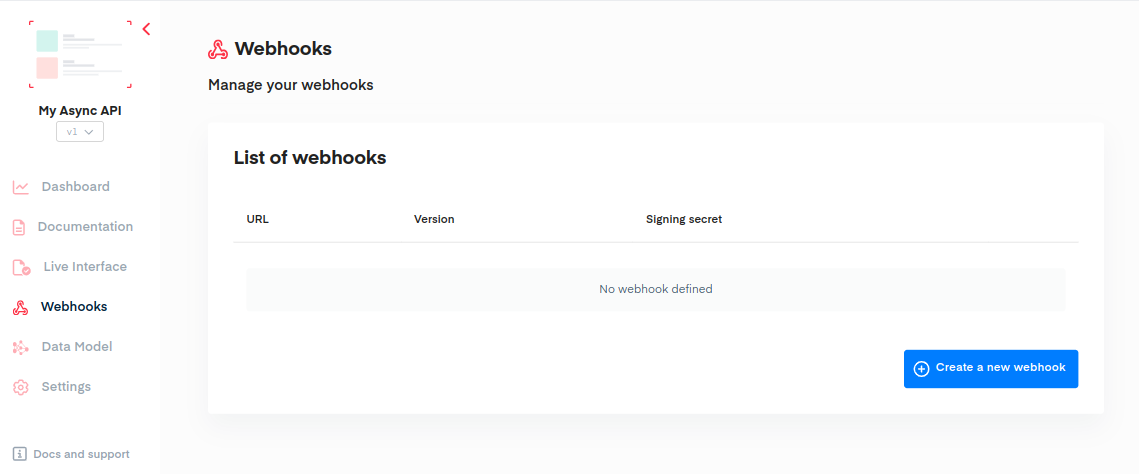
To do so, click on the **Webhooks** item from your API menu. On this interface you'll be able to create, edit or delete your webhooks configuration.
***Note:** you can define more than one active webhook for a single API, for example for your development and production environments.*
## Create a new webhook
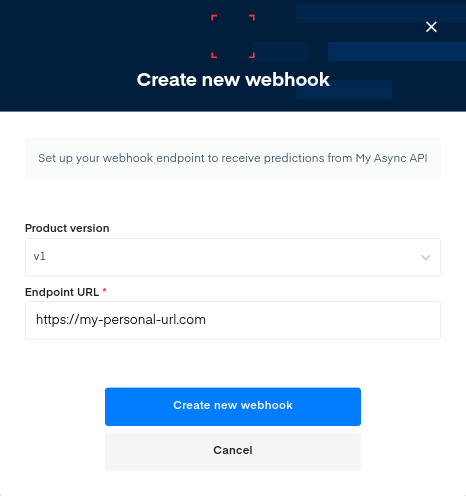
To create a new webhook, click on the `Create a new webhook` button. A form will show, with only two fields to fill:
* the product version you want your webhook to listen for
* the endpoint URL where the predictions will be sent\
*Although we accept any valid URL, we greatly recommend using an HTTPS URL here, to ensure your data security.*
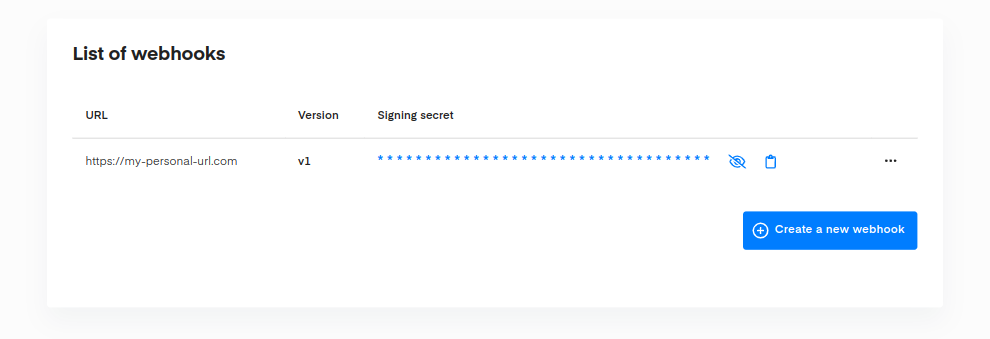
Simply click on the `Create new webhook` button in order to finalize your webhook creation. Once this is done, a new line will appear on your webhook list:
{% hint style="info" %}
**Signing Secret**
For every new webhook created, we will generate a custom `Signing secret`that can be used to ensure the integrity and authenticity of the data sent to your endpoint.\
See [how to validate the HMAC signature integrity](/v1/apis-overview/endpoints/prediction-asynchronous.md#validate-the-hmac-signature-optional).
You can, at any point in time, visualize your signing secret by clicking on the crossed eye icon. You can also click the clipboard icon in order to copy the secret to add it to your code easily.
***Note:** this key being a secret, it is not recommended to store it anywhere in plain-text, we recommend using environment variables.*
{% endhint %}
## Edit your Webhooks
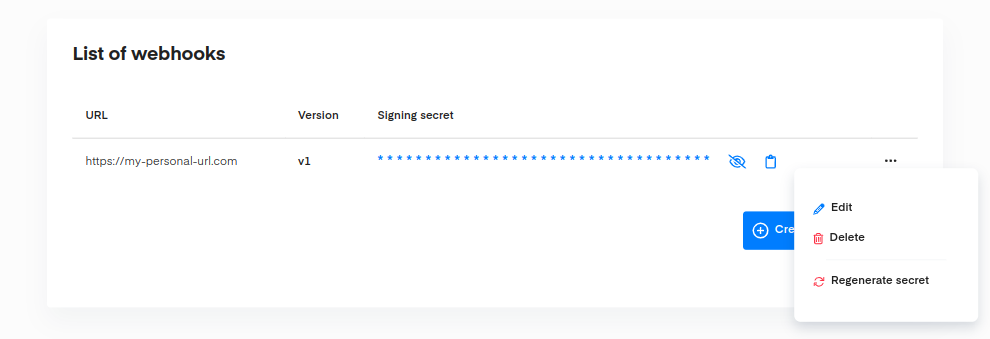
To Edit an existing webhook, click on the **...** button at the very end of your webhook item.
A floating menu will appear giving you the possibility to:
* Edit a webhook by changing the provided URL.
* Delete an existing webhook
* Regenerate your signing secret
***Note:** When validated, any of those actions will be immediately effective.*
---
# Agent Instructions
This documentation is published with GitBook. GitBook is the documentation platform designed so that both humans and AI agents can read, navigate, and reason over technical content effectively. Learn more at gitbook.com.
## Querying This Documentation
If you need additional information that is not directly available in this page, you can query the documentation by asking a question.
Perform an HTTP GET request on the following URL with the `ask` and `goal` query parameters:
```
GET https://docs.mindee.com/v1/platform-ui-tour/webhooks.md?ask=&goal=
```
`ask` is the immediate question: it should be specific, self-contained, and written in natural language.
`goal` is what the user is ultimately trying to achieve, the reason they need the answer. Sharing it helps GitBook give you a better, more relevant answer. A goal is most helpful when it describes the outcome the user wants rather than restating the question. For example, with `ask=how do I create an API token`, a goal like `automate deployments from our CI pipeline` lets GitBook tailor the answer to that use case.
The response will contain a direct answer to the question and relevant excerpts and sources from the documentation.
Use this mechanism when the answer is not explicitly present in the current page, you need clarification or additional context, or you want to retrieve related documentation sections.